
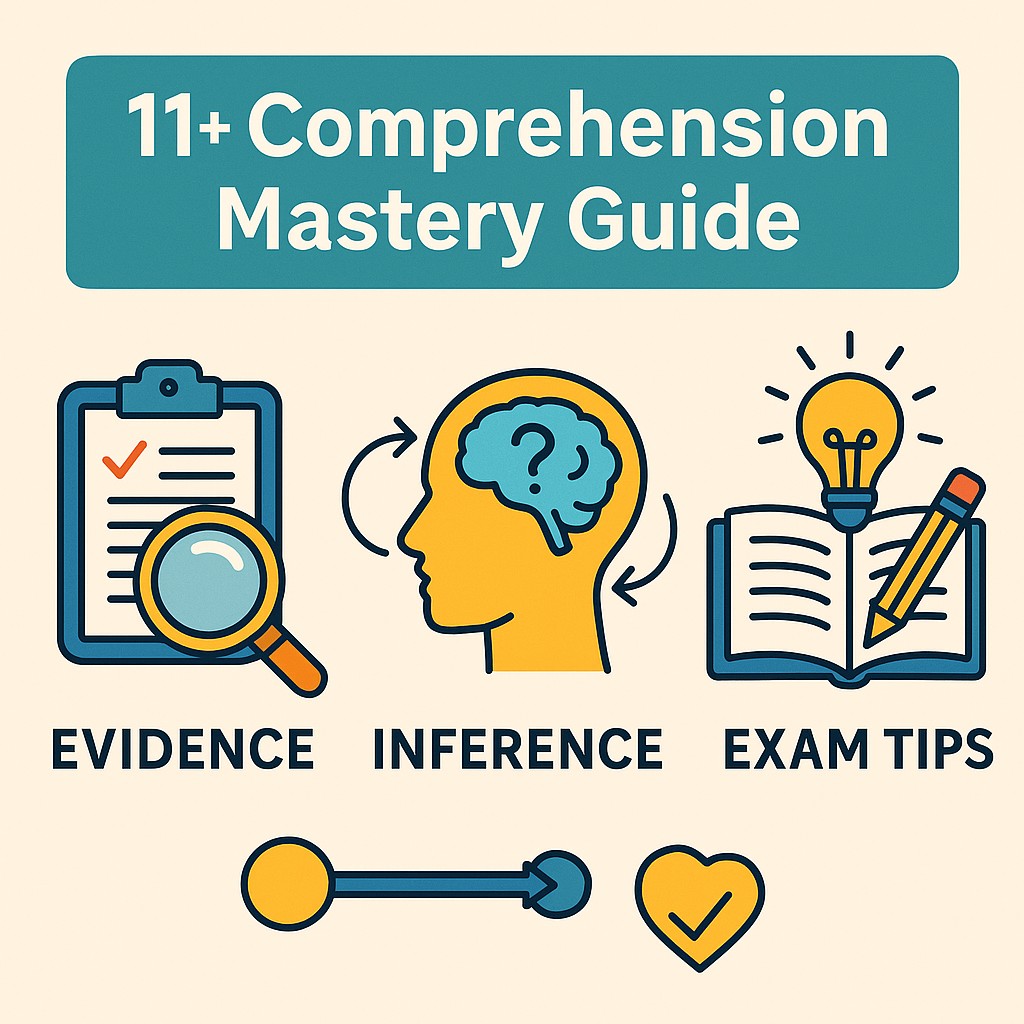
11+ Comprehension Mastery Guide
The 11+ exam is fast approaching, and for many parents, this final stretch feels like crunch time. At GLECTA, we’ve refined our Booster Tips & Mastery Techniques programme to focus on the skills that truly decide results.
This blog is a parent-friendly guide to everything your child needs for exam success in 2025 — from comprehension mastery to exam-day confidence.
Why Comprehension Is the Silent Decider
- In most 11+ exams, comprehension makes up 30–50% of marks.
- GL focuses on vocabulary + retrieval; CSSE/FSCE/CEM lean on inference; independents push for evaluation.
- Success isn’t just about reading — it’s about retrieving, inferring, and analysing quickly under pressure.
Building Daily Reading Habits
- Read widely: classics, modern novels, poetry, news, science.
- Mix paper, digital, and audio (like BBC Bitesize).
- 10–15 minutes daily aloud to sharpen fluency.
- Encourage summaries: “Tell me the story in 3 lines.”
The “Active Reader” Technique
- Underline keywords in questions.
- Circle evidence in passages.
- Add margin notes: “angry,” “contrast,” “humour.”
- Predict a question after each paragraph.
Deep Dive: Question Types
Teach children to spot the type instantly:
- Retrieval → “What did the boy drop?”
- Inference → “Why did he drop it?”
- Opinion → “Do you think he was careless?”
- Language effect → “How does this simile work?”
- Structure → “Why start with description not dialogue?”
- Compare/contrast (harder papers).
Time Management Micro-Tactics
- 1 mark = 1 minute rule.
- Parking strategy: stuck for 45 sec? Skip + return.
- Answer easy → medium → hard.
- Check progress halfway.
Answering Framework (P.E.E.)
- Step 1: Decode (retrieval? inference?).
- Step 2: Locate evidence.
- Step 3: Write full sentences.
- Step 4: P.E.E. = Point, Evidence, Explain.
Phrases to use: “This suggests that…”, “The effect on the reader is…”.
Vocabulary Toolbox Expansion
- Play synonym chains: angry → furious → enraged.
- Guess meanings in context before dictionary.
- Spot prefixes/suffixes (e.g., “-ous = full of”).
- Keep a glossary booklet of 100 tricky words.
Developing Critical Reading
- Spot bias: “Whose point of view is this?”
- Notice tone shifts.
- Ask “why” about structure.
These higher-level skills separate the average child from top 5% scorers.
Stamina & Concentration
- Weekly long passage drill: 30–45 mins.
- Distraction-free study.
- Track reading speed vs accuracy weekly.
Parent Coaching Notes
- Use hints, not direct answers.
- Always ask for evidence: “Which line supports you?”
- Praise processes: neatness, annotation, pacing.
Exam-Day Psychology
- Reset routine: deep breath → underline → scan passage.
- Use a 5-min calm drill to reduce anxiety.
- Teach growth mindset: “I haven’t mastered it yet.”
Revision Roadmap (Final 4 Weeks)
| Week | Action |
|---|---|
| Weeks 1–2 | 4–5 mixed passages, focus on weak question types. |
| Week 3 | Full timed comprehension papers. |
| Week 4 | Light review + inference & author’s effect drills. |
Parent-Friendly Weekly Plan
- Monday – Fiction extract (retrieval).
- Wednesday – Non-fiction (inference).
- Friday – Timed 10-min comprehension drill.
- Sunday – Family discussion: tone, vocabulary, author choice.
Troubleshooting
- Loses focus → break passages into chunks.
- Weak inference → practise “why” questions in daily life.
- Small vocab → word games like Wordle.
- Time anxiety → simulate with reduced time.
✨ GLECTA Advantage: How We Help
At GLECTA, we don’t just hand out worksheets. We train children in exam conditions:
- Mock exams under pressure – weekly/bi-weekly to track progress.
- Detailed feedback – spotting careless vs knowledge gaps.
- Exam hall coaching – time hacks, checking OMRs, avoiding silly mistakes.
- Confidence building – proven psychology techniques to reduce panic.
👉 Book a Free Consultation 👉 Explore 11+ Courses
❓ FAQs
Why is comprehension so important in the 11+?
Because it carries up to 50% of marks, especially in GL and other papers. It decides borderline passes.
How often should my child practise before the 11+?
Daily short sessions + one long timed practice weekly. From July onwards, add weekly mocks.
What’s the best way to expand vocabulary?
Use synonym chains, prefixes/suffixes, and cloze activities. GLECTA provides a curated vocab booster list.
How do GLECTA mocks help?
We simulate real exam conditions, mark papers with examiner-style feedback, and give predicted grades + next steps.
What if my child panics in exams?
Teach them our reset routine (deep breath → underline → scan). We coach this in our Booster sessions.
Do these strategies apply to independent school exams?
Yes, but with tweaks — independents often use evaluative/opinion-heavy comprehension.
What’s GLECTA’s unique value?
We blend subject mastery with exam-day coaching — ensuring children not only know the answers, but can perform under pressure.
🔗 Quick Links (Parents)