

Bexley 11+ Moves to QUEST:
What’s Changed & How to Prepare
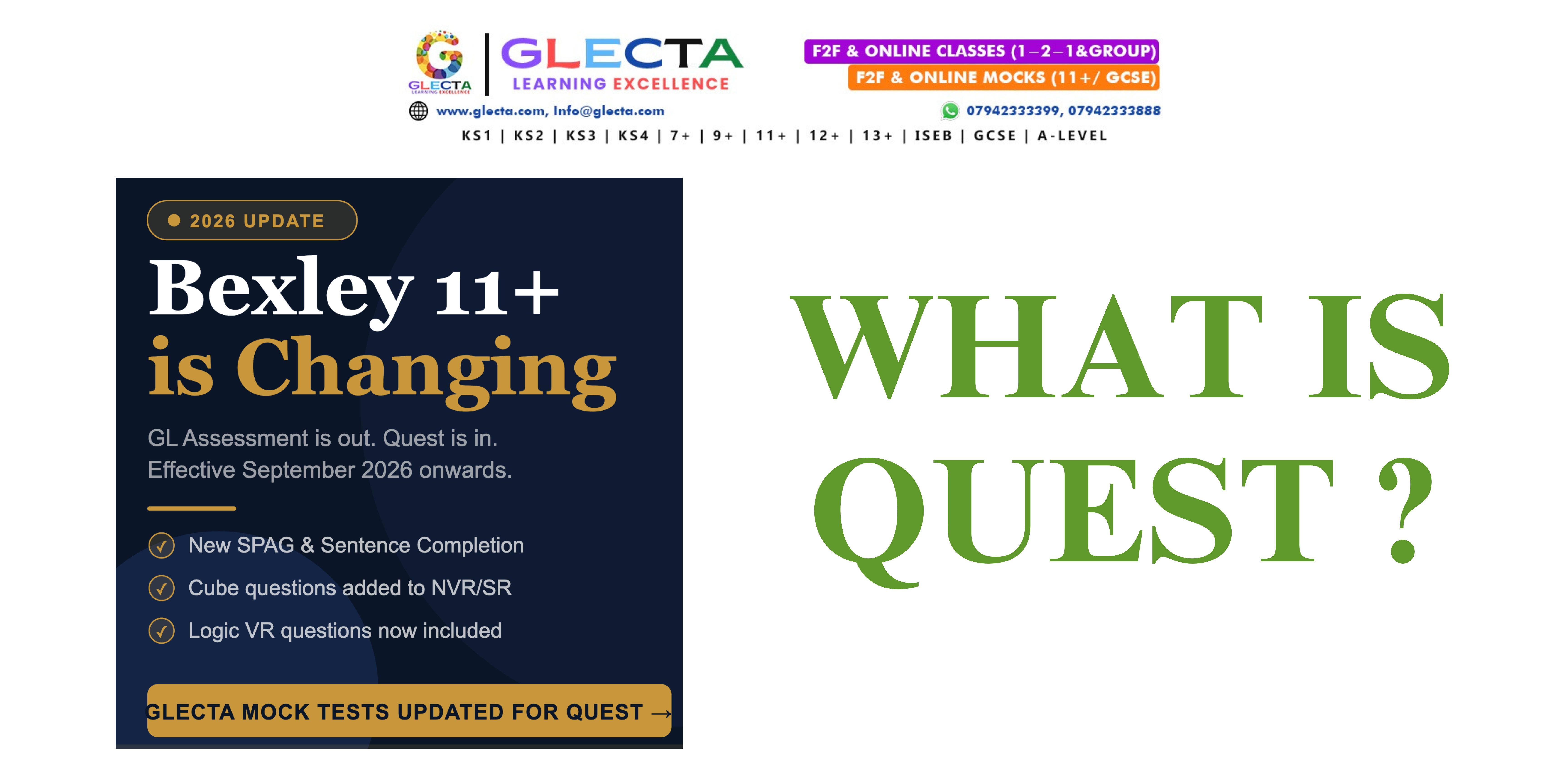
The most significant change to the Bexley Selection Test in years. GL Assessment is out, QUEST is in — and most families are still preparing the wrong way. Here is everything you need to know.
Important update for Bexley families: Bexley has officially moved to QUEST Assessment as the provider for its 11+ Selection Test from 2026 onwards. This affects every child currently in Year 4 or Year 5 preparing for grammar school entry. GLECTA’s mock tests and tuition have been fully updated to reflect this change.
What Exactly Has Changed?
After several years with GL Assessment, the London Borough of Bexley has moved to a new provider: QUEST Assessment. This affects all children competing for grammar school places across Bexley Grammar School, Beths Grammar School, Chislehurst and Sidcup Grammar School, Blackfen School for Girls, and Townley Grammar School for Girls.
The important reassurance for families is that the four core subject areas remain the same — English comprehension, Maths, Verbal Reasoning, and Non-Verbal Reasoning are all still tested. What has changed is how those subjects are tested: the question styles, the paper structure, and certain topic emphases within each section.
“QUEST does not test more content than GL. It tests the same content differently — with more focus on genuine reasoning and less reward for memorised technique.”
| Area | GL Assessment (old) | QUEST Assessment (2026+) |
|---|---|---|
| Subjects tested | English, Maths, VR, NVR | English, Maths, VR, NVR Same |
| Number of papers | Two ~50-minute papers | Two ~50-minute papers Same |
| Answer format | Multiple choice, OMR sheet | Multiple choice, OMR sheet Same |
| Scoring weights | 50% Verbal / 25% Maths / 25% NVR | 50% Verbal / 25% Maths / 25% NVR Same |
| SPAG question style | Spot any error in a text chunk | Single, targeted rule per question Changed |
| Sentence completion | Not a consistent formal section | Formal named section in Paper 1 New |
| VR question types | Codes, sequences, hidden words, analogies | Above + CEM-style logic/deduction New |
| Spatial reasoning: cubes | Not standard in Bexley papers | Included in NVR/SR section New |
| Content ceiling | Up to Year 6 curriculum | Capped at Year 5 curriculum Changed |
The New Paper Structure
Under both GL and QUEST, the test consists of two papers taken in the same sitting, each lasting approximately 50 minutes. Papers are divided into timed sections, with an invigilator moving children through at set intervals. Understanding the structure in advance reduces exam-day anxiety significantly.
Paper 1: Verbal Skills
~50 minutes · Multiple choicePaper 2: Maths & Reasoning
~50 minutes · Multiple choiceFive Key Differences From GL — In Detail
While the broad content is similar, the nuances matter enormously for preparation. Here are the five changes your child needs to be specifically ready for.
SPAG: More Focused, Less Open-Ended
GL asked children to spot any kind of punctuation error in an open chunk of text. QUEST tells you exactly which rule to look for in each question. This requires children to know punctuation rules by name and principle — not just by pattern recognition from drilling.
“Read the passage and find the section containing a punctuation mistake.”
(Any type, anywhere in the text)
“Which part of this sentence needs a question mark?”
(Single targeted rule being tested)
Sentence Completion — Now a Formal Section
The single biggest addition in Paper 1. QUEST formally includes Sentence Completion as a named, consistent section. Children must choose the word or phrase that best completes a sentence — testing grammar, vocabulary, and register simultaneously. This was not a reliable fixture in GL Bexley papers.
Sentence Completion was not a guaranteed, named section in the Bexley GL papers.
“Choose the word that best completes the sentence: The scientist made an _______ discovery.”
(A: incredibly B: incredible C: incredulous D: very)
Verbal Reasoning: Logic & Deduction Questions Added
GL’s VR format set was largely fixed — codes, sequences, analogies, hidden words. QUEST keeps these but adds CEM-style logic and deduction questions that require children to reason through scenarios step by step rather than recognise a format and apply a memorised shortcut.
Analogies, letter codes, hidden words, number sequences — learnable through repetition of a finite format set.
“If A is faster than B, and C is slower than A but faster than B, who is slowest?” — step-by-step deduction.
Spatial Reasoning: Cube Questions Now Tested
QUEST introduces cube questions into the Spatial Reasoning section — cube nets, cube face identification, and 3D rotation. These were not a standard part of the GL Bexley paper. Children who encounter them without specific preparation often freeze, even though the underlying logic is straightforward once learned.
Cube questions were not a standard feature of the GL Bexley papers.
Cube nets, cube face identification, and 3D cube rotation are now part of the Spatial Reasoning section.
Content Ceiling Lowered to Year 5
QUEST is explicitly capped at the Year 5 curriculum — no content beyond what is expected to have been taught in school by the end of Year 5 is required. This is a change from GL, which could draw on Year 6 content. The implication is significant: QUEST does not reward knowing more advanced content. It rewards understanding Year 5 content deeply and applying it flexibly.
GL papers could include Year 6 content, incentivising families to accelerate curriculum coverage.
No content beyond Year 5 is tested. Depth of understanding outperforms breadth of content coverage.
Why the Old Preparation Mindset No Longer Works
The most common mistake we see at GLECTA is families preparing hard and consistently — but in the wrong way. They are applying a GL-era strategy to a QUEST-era exam and finding that progress is slower than expected.
- Complete 20–30 mock papers back to back
- Memorise shortcuts for each question type
- Prioritise speed above reasoning quality
- Rely on familiarity with formats for confidence
- Judge progress by score on familiar papers
- Build deep Year 5 subject understanding first
- Develop reading and inference skills systematically
- Practise with unfamiliar and mixed-skill problems
- Learn strategies for handling unknown question types
- Measure progress by reasoning quality, not just score
The most dangerous false signal: A child scoring well on GL-style past papers is not necessarily well prepared for QUEST. If preparation has been purely technique-based, performance on genuinely QUEST-style questions may be significantly lower than expected. Discover this in a well-calibrated mock — not on exam day.
When to Start and How to Plan
QUEST rewards accumulated, genuine reasoning skills more than last-minute drilling. The earlier preparation begins, the more naturally those skills develop — and the less pressure falls on the final months before the exam.
Year 3 — Foundation
Build strong maths and English foundations. Introduce regular varied reading and discussion. No exam pressure — the goal is fluency and curiosity. GLECTA’s Year 3 Foundation course builds exactly this groundwork.
Year 4 — Core Development
Begin structured vocabulary and comprehension work. Introduce logical reasoning puzzles and problem-solving. Start light timed practice to build comfort under mild pressure. An ideal time to introduce QUEST-style thinking gently.
Year 5 — Focused QUEST Preparation
The critical year. Systematic QUEST-format mock tests, structured feedback on reasoning quality, and targeted work on all five areas where QUEST differs from GL. Parents should be receiving topic-level performance data and tracking improvement in reasoning, not just overall scores.
Year 6 — Consolidation
Consolidation, exam-conditions practice, strategy refinement, and confidence building. Not a time to introduce new content — a time to sharpen and stabilise what has already been built. GLECTA’s intensive and half-term courses serve this phase directly.
Seven Preparation Tips for QUEST
Beyond the general mindset shift, here are seven specific, actionable preparation tips for families preparing for the new Bexley format.
- 1Prioritise reading above everything else. The comprehension section carries significant weight, and strong reading habits underpin both English and Verbal Reasoning. Aim for 20–30 minutes of varied reading daily — fiction, non-fiction, news articles, and age-appropriate classics all build the inference skills QUEST tests.
- 2Practise Sentence Completion systematically. This is the biggest new addition and most children will not have encountered it in standard school work. Practise choosing the best word or phrase to complete a sentence, paying attention to grammar, register, and precise meaning. GLECTA’s updated mock series includes full Sentence Completion sections.
- 3Learn SPAG rules by name, not by instinct. Because QUEST tests specific punctuation rules in focused questions, children who genuinely understand when to use a semicolon, a colon, or a question mark will outperform those who rely on a general feel for what looks wrong.
- 4Add logic VR questions to your practice rotation. If preparation has relied solely on GL-style VR books, supplement with CEM-style materials (Bond, CGP CEM books) for the logic and deduction question types QUEST now includes. GLECTA tutors cover these specifically in weekly sessions.
- 5Give cube questions dedicated practice time early. Many children freeze when they first see cube net questions. A few focused sessions early on demystifies them entirely — they follow simple, learnable rules once understood, and children who practise them gain a reliable advantage in the Spatial Reasoning section.
- 6Sit full timed mock tests regularly. The timed section-by-section format of the Bexley test means pacing matters enormously. Children who have practised under real time pressure perform significantly better. GLECTA’s Bexley mock exam days replicate the exact QUEST format and timings.
- 7Review mistakes immediately after every mock. A mock only adds value if errors are understood and learned from. Every GLECTA mock includes a topic-level score breakdown so parents and children can identify weak areas and target them before the real exam.
How GLECTA Can Help
GLECTA has been preparing Bexley children for the 11+ for years. When the test changes, we change with it. Our materials, mock tests, and tuition have been fully rebuilt for QUEST Assessment — not relabelled GL papers, but a genuinely redesigned programme built around what the new format actually tests.
QUEST-Format Mock Tests
Our Bexley mock series mirrors the exact QUEST paper structure — Sentence Completion, targeted SPAG, logic VR, and cube questions. Every paper reflects the real exam your child will sit.
Detailed Cohort Performance Reports
Topic-level score breakdowns after every mock, with comparison to the cohort standard. We identify exactly where marks are being lost and what to prioritise next.
Expert Tuition — In-Centre & Online
Our tutors cover all four subject areas with specific focus on the QUEST question types new to Bexley. Classes at Bexley, Ilford, Medway, Harrow, and Barnet, plus online.
Bexley Mock Exam Days
Full mock exam sessions replicating the Bexley Selection Test environment exactly — invigilated, timed, and sat in exam conditions. The best way to build genuine confidence.
Targeted QUEST Resources
Dedicated materials for Sentence Completion, cube questions, logic VR, and focused SPAG — the areas where QUEST differs from GL. Available in-centre and online.
Year-Round Programmes
Structured preparation from Year 3 through pre-exam Year 6, building skills gradually so children are fully ready — not rushed — when exam day arrives.
Our centres
All centres deliver the same QUEST-aligned programme. Families can attend at any GLECTA location and access the same mocks, reports, and expert tuition.
Explore our courses
Frequently Asked Questions
My child has been doing GL past papers. Is that preparation wasted?
Not entirely. The underlying maths and English subject knowledge transfers directly — QUEST is still capped at Year 5 curriculum content. What transfers less well are the technique-based shortcuts, pattern-recognition strategies, and pacing approaches built for a fixed format set. Rebalance preparation toward reasoning quality and genuine understanding as soon as possible, rather than continuing to drill GL-specific formats.
Does QUEST require children to know more content than GL?
No — and in fact the opposite. QUEST is explicitly capped at the Year 5 curriculum, which is lower than GL’s ceiling of Year 6. Children are not expected to know anything beyond what is taught in school by the end of Year 5. What QUEST demands is not more knowledge, but deeper and more flexible understanding of what children already know.
Is QUEST harder or easier than GL Assessment?
It is a different kind of challenge. QUEST can feel harder for children who relied heavily on memorised techniques. For children with strong natural reasoning and deep subject understanding, it may feel more manageable. The targeted SPAG format is arguably more straightforward than GL’s open-ended error-spotting. Cube questions and logic VR add new challenge areas that respond well to dedicated practice.
Will QUEST release past papers for practice?
QUEST Assessment, like GL before it, does not release official past papers. The London Borough of Bexley will provide familiarisation materials to registered families after the registration window opens. These are useful for format familiarity but are not sufficient as the only preparation resource. GLECTA’s mock series provides comprehensive practice across all QUEST question types, including the sections not covered in official materials.
What is the selective standard score for the Bexley 11+?
There is no fixed pass mark. Children are ranked by age-standardised score, and each year the selective standard is agreed between the Council and the participating grammar schools. Under GL, the minimum to meet the selective standard has historically been around 216, with top applicants scoring 246 or above. Under QUEST, the scaling and standard-setting will be recalibrated for the new format, but the competitive dynamic remains the same.
How early should preparation start for the new Bexley format?
Ideally, structured reasoning and comprehension work begins in Year 3 or Year 4. QUEST-format mock practice should be a consistent part of Year 5 preparation. Starting earlier gives more time to build genuine reasoning skills rather than compressing preparation into a rushed final phase. A well-structured Year 5 or early Year 6 start can still be highly effective if focused on the right skills from day one.
My child is strong at GL — will they still do well in QUEST?
If their GL performance is driven by genuine subject ability and strong reasoning, then yes — they are likely to transition well. If their scores were built primarily on technique and format familiarity, more adjustment may be needed. A QUEST-style diagnostic mock is the fastest way to establish which is the case. GLECTA can run this and give a clear, actionable picture within a single session.
Which GLECTA centres offer Bexley 11+ preparation?
GLECTA offers Bexley 11+ preparation at our centres in Bexley, Ilford, Medway, Harrow, and Barnet — as well as online. Our Bexley mock exam days are open to all students regardless of which centre they normally attend. Contact us at [email protected] or call 07942 333399 to find out what is available near you.
Ready to Prepare for the New Bexley 11+?
Book a QUEST-aligned mock test or speak to our team about the right programme for your child’s year group and starting point.